
A bridge is never just a structure. Its meaning depends on what surrounds it: the terrain it crosses, the water beneath it, the paths leading toward it, and the landscape that gives it context. When these elements are reduced to a physical architectural model, representing water realistically becomes especially important. A flat blue surface may identify a river, but it rarely communicates the depth, movement, and relationship between the water and the structure.
This is where resin water effects can make a significant difference. Carefully tinted and finished resin can reproduce the appearance of rivers, streams, ponds, canals, and other water features while maintaining the scale and visual language of a physical model. Water can become an integrated part of the landscape rather than an afterthought.
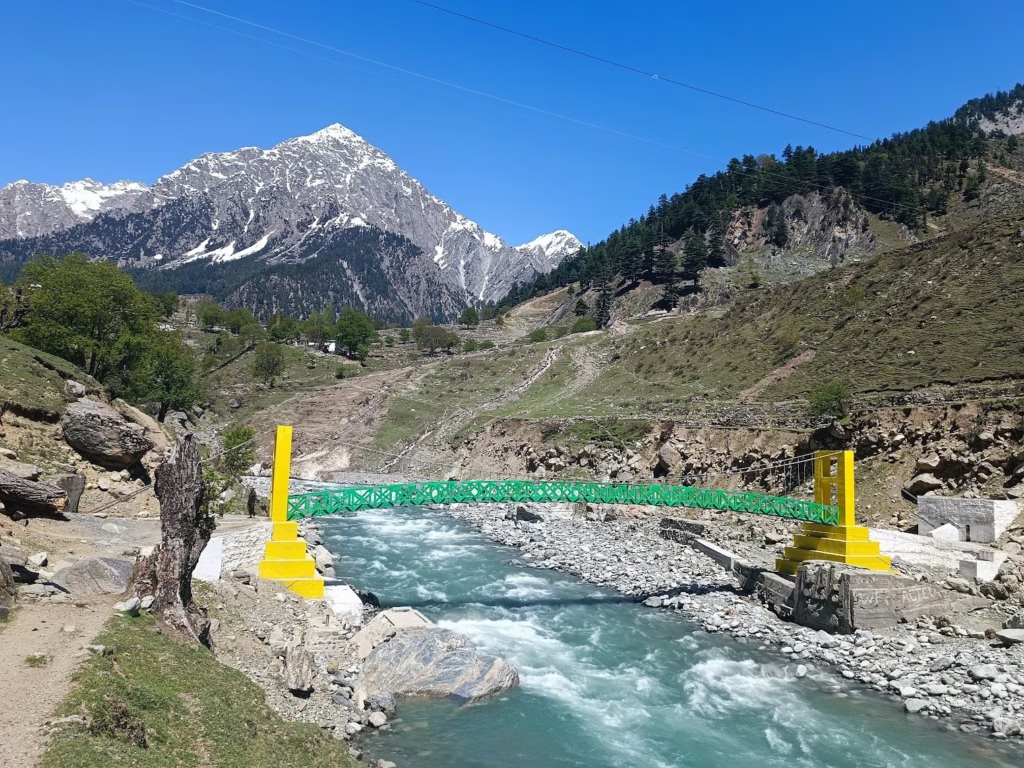
Our work on the UNOPS Swat Water Bridge (Pedestrian) demonstrates this approach particularly well. The project required a detailed 3D model within an urgent one-week timeframe. Instead of presenting only the bridge, the model incorporated the surrounding terrain, river, and site context using a combination of 3D printing, acrylic materials, and pigmented resin. The result was a physical representation that showed the bridge as part of its environment.
Why Water Representation Matters in 3D Architectural Model Making & Manufacturing
Architectural models are often used to communicate relationships that can be difficult to understand from drawings or digital views. This becomes even more important for infrastructure projects where terrain and natural features directly influence how a structure is perceived.
A pedestrian bridge crossing a river, for example, cannot be fully understood by showing only the bridge deck and supports. The river establishes the crossing point. The surrounding terrain explains the approach. The banks provide context. Together, these elements tell the story of the project.
For 3D Architectural Model Making & Manufacturing, accurately representing these relationships requires more than simply selecting materials that look attractive. Every material needs to support the scale, geometry, and purpose of the model.
Resin is particularly useful for water because it can create a smooth, reflective and translucent surface. Depending on the desired appearance, it can also be tinted with pigments and built up to suggest depth. Architectural landscape models commonly use resin or acrylic to simulate water features, while surrounding terrain can be constructed from other materials suited to the required contours and textures.
For an infrastructure presentation, this distinction matters. The objective is not to make the water look decorative. It is to make the entire site easier to read.
UNOPS Swat Water Bridge: A Case Study in Resin Water Model Making
The UNOPS Swat Water Bridge (Pedestrian) project presented a specific challenge: the model needed to communicate a bridge and its surrounding environment while being completed on an urgent schedule.
The physical model was approximately 1.5′ 2 feet and had a one-week production timeframe. That meant the approach had to balance visual detail, material selection, production speed, and the physical limitations of the final model.
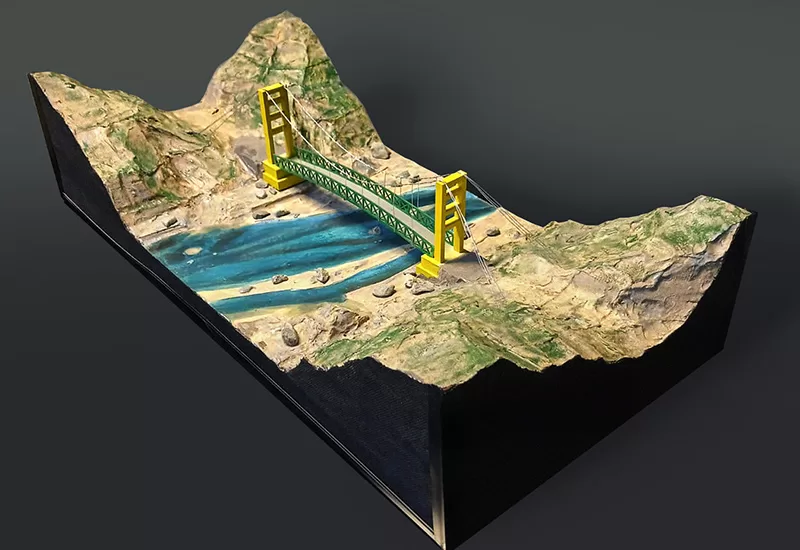
Rather than treating the bridge as an isolated object, the model was developed to show the surrounding area as well.
The approach included:
- 3D-printed components for the required structural and architectural forms
- Acrylic materials for selected model elements
- Represented terrain around the bridge
- A river and water environment
- Pigmented resin to reproduce the appearance of water
- Surrounding site details to provide greater context
This combination was important because no single material could effectively communicate every part of the scene.
How the Resin Water Effect Was Used
The river was one of the most visually important elements of the model. Instead of using a simple blue sheet or painted surface, pigmented resin was used to represent the water.
Resin water effects are effective because they can provide characteristics associated with real water, including surface gloss, visual depth and translucency. Depending on the formulation and application, resin can also be layered or finished to create different visual effects. Scale-modelling techniques commonly use clear or tinted resin for rivers and other water features, with additional surface treatments used to suggest movement or ripples.
For the Swat Water Bridge model, the objective was not to reproduce every physical property of a real river. At architectural-model scale, excessive realism can actually make a model visually confusing. The water needs to look convincing from the viewing distance while remaining consistent with the rest of the model.
That is why pigment, finish, scale and surrounding terrain all need to work together.
Why the River Was More Than a Visual Detail
One of the important decisions in the UNOPS project was to show the river and surrounding terrain rather than only the bridge.
This changed the way the model communicated the project.
A bridge model displayed on its own can explain the basic form of the structure. A contextual model can explain the relationship between the structure and its location.
For the Swat Water Bridge, the river established the reason for the bridge’s existence within the physical scene. The surrounding terrain helped establish the setting, while the pedestrian structure became part of a larger landscape.
That distinction is important when producing 3D architectural models for infrastructure, development, engineering, government, or institutional presentations.
How Architectural Model Makers Create Realistic Water Effects
Creating realistic miniature water is not simply a matter of pouring resin into a shape. The surrounding model has to be prepared first, and the water effect needs to be considered as part of the overall composition.
Professional architectural model makers generally need to consider several factors.
1. Understanding the Actual Site
Reference material is essential. The model maker needs to understand the approximate shape of the river, its relationship to the banks, the surrounding terrain, and the position of the structure.
A water effect should follow the site’s geometry rather than being added as an independent decorative feature.
2. Selecting the Appropriate Scale
Scale determines how much detail can realistically be represented.
A large-scale architectural model may allow more visible surface variation, while a smaller site model may require a simpler treatment. At smaller scales, excessive ripples, textures, or colour variation can appear exaggerated.
The water should therefore be designed for the viewing distance of the final model.
3. Preparing the River Bed
The surface underneath the resin contributes to the perceived depth of the water. Colour, texture and contours can be used beneath a transparent or translucent layer to create a more convincing visual result.
This is particularly useful for shallow rivers and streams where the viewer may need to perceive the relationship between the water and the riverbed.
4. Choosing Resin Colour Carefully
Real rivers are rarely a uniform bright blue.
Depending on the environment, water may appear blue, green, grey, brown, or a mixture of subtle tones. A realistic architectural model should therefore consider the character of the actual site.
Pigmentation needs to be controlled carefully because too much pigment can reduce the transparency that gives resin its water-like appearance.
5. Controlling the Surface Finish
A glossy surface can help represent reflected light, but the finish should remain appropriate to the scale.
Where necessary, additional surface treatments can suggest movement without making the river look oversized. Resin water modelling techniques commonly combine a resin base with gloss mediums or other surface effects to create the appearance of flowing water.
The Material Combination Behind the Swat Bridge Model
The UNOPS Swat Water Bridge project also demonstrates why an architectural model making company should not approach every component with the same material.
The model used a combination of 3D printing and acrylic, while pigmented resin was selected for the river.
| Model Element | Approach Used | Purpose |
|---|---|---|
| Bridge components | 3D printing | Accurate reproduction of structural forms |
| Selected model elements | Acrylic | Clean, precise physical components |
| River | Pigmented resin | Water-like appearance and visual depth |
| Terrain | Physical model detailing | Establishes site context |
| Overall base | Combined materials | Brings structure and landscape together |
This material strategy is particularly useful for complex projects because different manufacturing methods can be assigned to the elements where they perform best.
A 3D model making company does not necessarily need to rely on one production technique. Digital fabrication can handle complex geometry, while acrylic and other materials can provide clean surfaces and finishes. Resin can then be reserved for elements where transparency, gloss, or depth are important.
Why the One-Week Requirement Changed the Approach
The Swat Water Bridge model had to be completed within one week, making production planning a major consideration.
An urgent architectural model cannot be treated like an unlimited-duration craft project. Every material and fabrication method needs to be selected with the deadline in mind.
For this project, the combination of 3D printing, acrylic and pigmented resin allowed the model to achieve the required visual representation without unnecessarily complicating the production process.
The important lesson is that speed should not mean removing context.
Instead, the production strategy should identify which details are essential to communicating the project and allocate time and materials accordingly.
That principle is especially relevant to organisations such as UNOPS, engineering firms, infrastructure consultants and development agencies that may need physical models for presentations, reviews or stakeholder communication within defined project schedules.
UNOPS’ work in Pakistan includes infrastructure and project support, while its Pakistan programme has included significant work connected with water, WASH and resilient communities.
What Makes Resin Water Look Realistic at Architectural Scale?
The strongest resin water effects usually come from restraint rather than excessive detail.
For an architectural model, realism depends on the relationship between several elements:
- Colour: Should relate to the actual environment.
- Transparency: Helps create visual depth where appropriate.
- Surface finish: Provides reflections and a water-like appearance.
- Scale: Prevents waves and textures from looking oversized.
- Context: Banks, rocks, terrain and structures make the water believable.
- Lighting: Natural or exhibition lighting can significantly affect how resin reflects light.
A common mistake is focusing on the water alone. Even an excellent resin surface can look artificial if the riverbanks, terrain, bridge supports and surrounding landscape do not correspond with it.
The Swat model therefore treated the river as one component of a complete physical environment.
How BD3D Approaches Complex Architectural Models
BD3D’s approach is built around combining design, technology and physical production rather than treating model making as a single-process activity. The company has been operating since 2015 and provides architectural scale modelling alongside product design, 3D visualization and other production services.
For projects where the client already has digital files, the production process can begin by analysing the CAD model and determining the appropriate manufacturing approach. BD3D also states that it can develop 3D CAD files from 2D drawings when required.
That flexibility becomes important when a project includes several different requirements, such as:
- A complex structure that benefits from 3D printing.
- Transparent or precision-cut elements requiring acrylic.
- Terrain that needs physical shaping and finishing.
- Water that requires resin.
- A strict presentation deadline.
The UNOPS Swat Water Bridge model brought these requirements together in one compact physical representation.
Frequently Asked Questions About Resin Water in Architectural Models
1. Can resin be used to create rivers in architectural models?
Yes. Resin can be used to simulate rivers, streams, ponds and other water features. It can remain clear or be carefully tinted depending on the desired appearance and scale.
2. Why use resin instead of painted blue acrylic for water?
Resin can provide greater visual depth, gloss and translucency. This makes it useful when the water needs to appear as a physical part of the landscape rather than a flat graphic surface.
3. Can resin water be coloured?
Yes. Pigments can be introduced to resin to create different water tones. The amount of pigment needs to be controlled because excessive colouring can reduce transparency.
4. Can 3D printing and resin be used in the same architectural model?
Absolutely. Different manufacturing methods can be combined according to the requirements of individual components. The Swat Water Bridge model is an example of 3D printing being combined with acrylic and pigmented resin.
5. What scale is best for a model with a river?
There is no single best scale. The appropriate scale depends on the size of the site, the required level of detail, available display space and viewing distance.
6. Can architectural models show terrain and water together?
Yes. In fact, combining terrain and water can make infrastructure projects considerably easier to understand because the viewer can see the relationship between the structure and its environment.
7. How long does it take to make a 3D architectural model?
The timeframe depends on the model’s size, complexity, materials, quantity and finishing requirements. BD3D notes that production time varies according to these factors.
8. Can an urgent architectural model be completed in one week?
It can be possible when the design, materials, production methods and scope are planned around the deadline. The UNOPS Swat Water Bridge project demonstrates how a detailed physical model can be developed within a one-week timeframe when the production approach is carefully coordinated.
Conclusion:
The purpose of resin water in an architectural model is not simply to make a river look attractive. Its real value is in helping the viewer understand the relationship between architecture, infrastructure and the environment around it.
The UNOPS Swat Water Bridge (Pedestrian) project demonstrates this clearly. Within a one-week timeframe, the model combined 3D printing, acrylic, terrain representation and pigmented resin to show more than the bridge itself. It presented the bridge within its river and surrounding landscape, creating a more complete physical interpretation of the project.
For architects, engineers, infrastructure organisations and development agencies looking for an experienced architectural model making company, material selection is only one part of the challenge. The bigger question is how every element of the model can work together to communicate the project accurately.
BD3D provides 3D Architectural Model Making & Manufacturing and on-demand physical model production, combining digital modelling with practical manufacturing methods. If your next project includes terrain, bridges, rivers, infrastructure or other complex site conditions, contact BD3D and discuss the required scale, materials, finish and delivery timeframe with the team.