
Water is one of the most difficult elements to represent in an architectural scale model. Unlike buildings or terrain, water is constantly changing in appearance, reflecting light, movement, depth, and its surrounding environment. For bridge and infrastructure projects, simply colouring a surface blue is rarely enough to communicate the relationship between a structure and the landscape. This is why resin water effects have become an important technique in 3D Architectural Model Making & Manufacturing, allowing architectural models to present a project more realistically.
For infrastructure developments, stakeholders need to understand more than the structure itself. Engineers, planners, government authorities, and funding organisations often need to evaluate how bridges, roads, and public facilities interact with rivers, streams, and surrounding terrain. When these natural elements are missing or poorly represented, it becomes more difficult to visualise the project in its real environment. High-quality resin water effects solve this problem by creating a realistic representation that improves the overall understanding of the design.
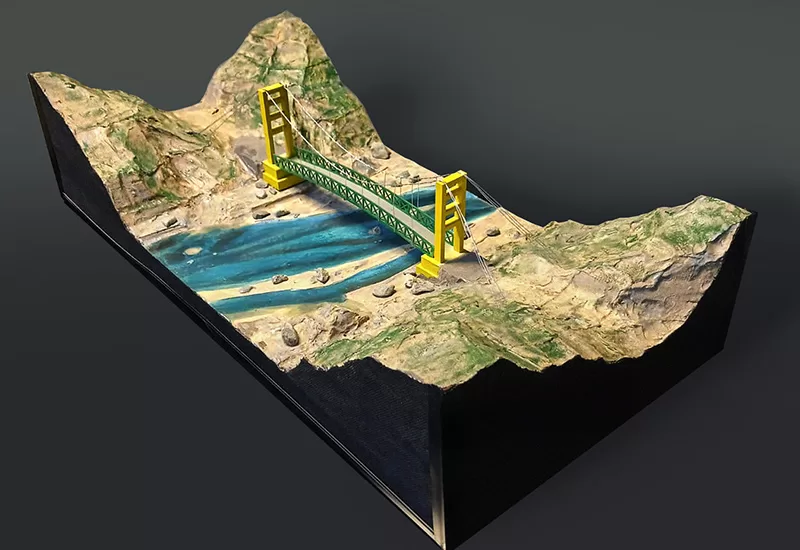
A project completed by BD3D for UNOPS demonstrates how this approach enhances architectural models. The Swat Pedestrian Water Bridge required an urgent 1.5′ 2 architectural model that accurately represented not only the bridge itself but also the surrounding terrain, river, and landscape. Using a combination of 3D printing, acrylic fabrication, and pigmented resin, the finished model recreated the natural setting of the bridge, helping stakeholders understand how the proposed infrastructure would integrate with its environment.
Why Water Representation Matters in Infrastructure Models
Bridge projects are influenced by much more than structural engineering. River flow, terrain, elevation, and nearby land all affect how a bridge functions and how it is perceived during planning.
Traditional architectural models sometimes simplify water into flat coloured surfaces. While this may identify the location of a river, it rarely communicates depth, reflection, or the relationship between water and the surrounding landscape.
Resin water effects address this limitation by adding realism that helps viewers interpret the project more naturally.
For infrastructure models, realistic water representation helps illustrate:
- River boundaries.
- Bridge positioning.
- Changes in terrain.
- Connections between land and water.
- Overall environmental context.
These details make the model more informative without overwhelming the viewer with technical information.
The UNOPS Swat Pedestrian Water Bridge Project
The UNOPS Swat Pedestrian Water Bridge was developed as a presentation model for an important infrastructure project requiring both accuracy and realism.
Rather than focusing exclusively on the bridge structure, the objective was to represent the complete environment surrounding the project. This included the bridge, the terrain, the flowing river, and the adjacent landscape.
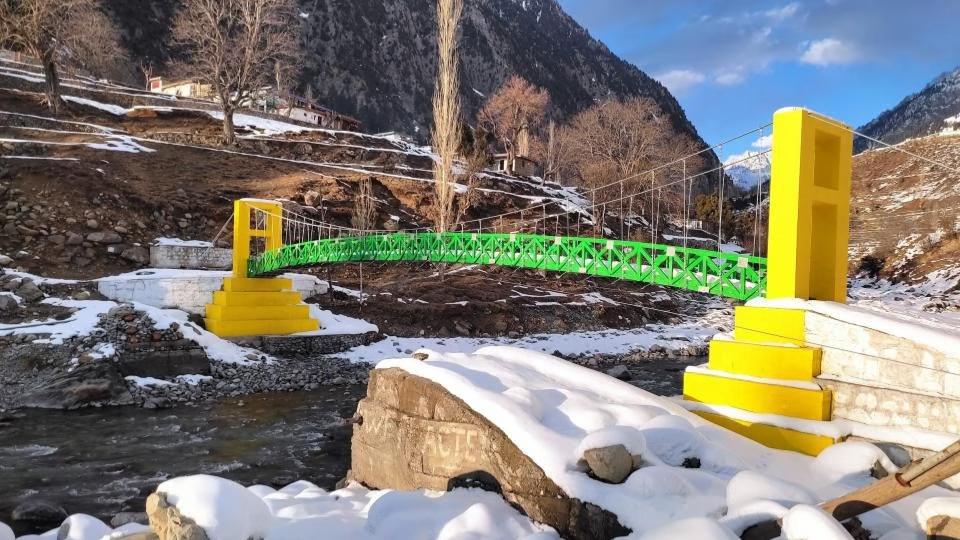
The completed model measured approximately 1.5′ 2 feet, providing enough space to reproduce key site features while remaining practical for transportation and project presentations.
To achieve the desired level of realism, multiple manufacturing techniques were combined throughout production.
Combining Materials for a Realistic Result
No single material can accurately represent every element of an infrastructure project.
For the Swat Pedestrian Water Bridge, different materials were selected based on the characteristics of each feature.
The bridge components were produced using 3D printing, allowing detailed structural elements to be manufactured with precision.
Acrylic materials provided clean finishes and durable construction for the overall model.
Finally, pigmented resin was used to recreate the river itself.
Rather than appearing as a flat coloured surface, the resin introduced depth, transparency, and subtle reflections that made the river feel like a natural part of the landscape.
This careful combination of materials allowed the model to present the project as a complete environment rather than a collection of separate components.
Why Pigmented Resin Was the Right Choice
Creating realistic water requires more than colour alone.
Pigmented resin offers several qualities that make it particularly effective for architectural models.
It can reproduce:
- Water depth.
- Surface transparency.
- Light reflection.
- Smooth flowing appearance.
- Natural transitions between land and water.
These characteristics helped the Swat Pedestrian Water Bridge model communicate the project’s environmental context more effectively.
Instead of drawing attention only to the bridge, the resin water feature encouraged viewers to understand how the structure interacted with the surrounding river.
Showing the Complete Environment
Infrastructure projects are shaped by their surroundings.
For the UNOPS project, representing the bridge without the surrounding river and terrain would have provided only part of the story.
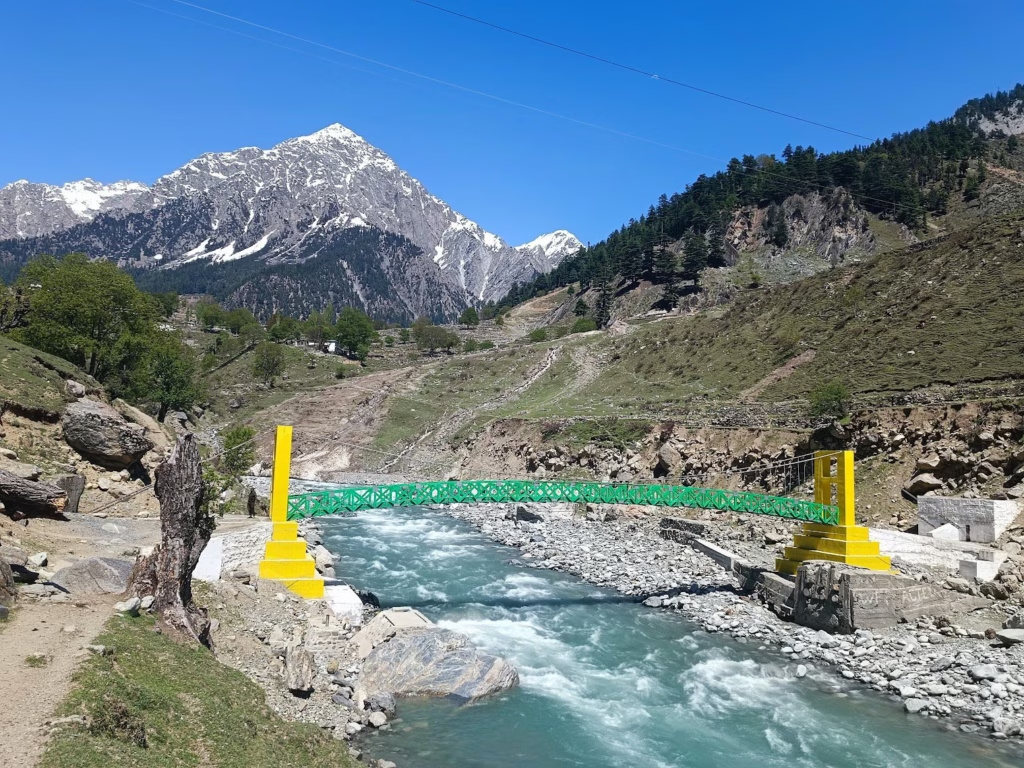
Including realistic landscape elements allowed stakeholders to evaluate:
| Model Element | Purpose |
|---|---|
| Bridge | Represent the proposed crossing. |
| Terrain | Show elevation and landform changes. |
| Pigmented resin river | Recreate realistic water conditions. |
| Surrounding landscape | Provide environmental context. |
| Overall site layout | Improve understanding of the complete project. |
This comprehensive representation transformed the architectural model into an effective planning and presentation tool rather than simply a scaled replica of the bridge.
More Than an Aesthetic Feature
One of the biggest misconceptions about resin water effects is that they exist only to improve appearance.
In reality, they contribute directly to how a project is understood.
For the Swat Pedestrian Water Bridge, the realistic river helped viewers immediately recognise the bridge’s relationship with the surrounding landscape. Instead of interpreting engineering drawings, stakeholders could see how the infrastructure would function within its natural setting.
This ability to communicate context is one of the reasons experienced architectural model makers continue to incorporate advanced material techniques into infrastructure models.
How Resin Water Effects Improve Stakeholder Communication
One of the biggest challenges in bridge and infrastructure planning is ensuring that everyone involved shares the same understanding of the project. Engineers may be comfortable reviewing CAD drawings and BIM files, but project sponsors, government officials, community representatives, and investors often need a more intuitive way to evaluate a proposal.
The UNOPS Swat Pedestrian Water Bridge model addressed this challenge by presenting the project in a way that required no technical interpretation. The combination of realistic terrain, detailed bridge components, and a pigmented resin river allowed stakeholders to immediately understand how the bridge would sit within its natural environment.
Instead of imagining the relationship between the bridge and the river from technical drawings, viewers could see it for themselves. This made project discussions more focused and reduced the chances of miscommunication during presentations.
Why Material Selection Matters in a 3D Model Making Company
Every architectural model requires materials that best represent different parts of the project. Choosing the wrong material can reduce realism, while selecting the right combination enhances both accuracy and presentation quality.
For the Swat Pedestrian Water Bridge, BD3D combined multiple manufacturing techniques to achieve the desired outcome.
- 3D printing produced detailed bridge components with high precision.
- Acrylic provided durability and clean finishes for the model’s structural elements.
- Pigmented resin recreated the river with realistic depth and transparency.
- Carefully crafted terrain completed the environmental context.
This balanced approach allowed the model to accurately communicate the entire project instead of focusing only on the bridge.
For an experienced 3D model making company, material selection is not just a production decision, it is an important part of how the final model tells the project’s story.
Creating a Complete Landscape Instead of an Isolated Structure
Infrastructure projects are closely connected to their surroundings. A bridge crossing a river cannot be fully understood without also showing the landscape around it.
The Swat Pedestrian Water Bridge model was designed to recreate the complete site, including:
- Natural terrain and elevation changes.
- Riverbanks and flowing water.
- The bridge structure.
- Adjacent landscape features.
By combining these elements, the model provided a realistic representation of how the completed bridge would integrate with its environment.
This approach made the model far more valuable during planning meetings because stakeholders could evaluate the project as a complete system rather than as an isolated structure.
Lessons from the UNOPS Swat Pedestrian Water Bridge
The project demonstrates several key principles that apply to bridge and infrastructure modelling.
Context Improves Understanding
Displaying only the bridge would not have communicated the full scope of the project. Including the surrounding terrain and river created a clearer picture of how the infrastructure interacts with the site.
Realistic Water Adds Meaning
The pigmented resin river was not simply a decorative feature. It helped viewers understand the bridge’s purpose, location, and relationship with the surrounding landscape.
Careful Material Selection Creates Better Results
Combining 3D printing, acrylic fabrication, and resin allowed each part of the model to be represented using the most suitable manufacturing technique.
Attention to Detail Builds Confidence
Small details such as terrain contours, river edges, and surface finishes contributed to a model that looked professional and accurately reflected the proposed infrastructure.
Supporting Better Bridge and Infrastructure Planning
A professionally produced architectural model helps simplify complex infrastructure projects.
For bridge developments, it enables stakeholders to better understand:
| Planning Objective | How the Model Helps |
|---|---|
| Site evaluation | Displays terrain, river, and bridge together. |
| Design presentations | Makes technical concepts easier to understand. |
| Stakeholder discussions | Creates a shared visual reference. |
| Infrastructure planning | Shows how different site elements interact. |
| Project communication | Reduces reliance on technical drawings alone. |
These practical advantages explain why physical 3D architectural models continue to play an important role in infrastructure planning.
Conclusion
Successful bridge projects require more than accurate engineering; they require clear communication. The UNOPS Swat Pedestrian Water Bridge demonstrates how realistic resin water effects can transform a physical model into a comprehensive planning tool that accurately represents both the structure and its surrounding environment.
By combining 3D printing, acrylic fabrication, detailed terrain modelling, and carefully crafted pigmented resin, BD3D created a model that presented the project as a complete landscape rather than simply showcasing a bridge. This attention to detail helped stakeholders better understand the design while supporting more informed planning and presentation discussions.
As a trusted architectural model making company, BD3D specialises in 3D Architectural Model Making & Manufacturing for infrastructure, commercial, residential, and public-sector developments. Our team creates custom 3D architectural models that combine precision, craftsmanship, and realistic detailing to help clients communicate complex projects with confidence.
To see more of our work, explore our Services, Portfolio, National Projects, International Projects, and Related Blogs, or Contact BD3D to discuss your next bridge or infrastructure model.