
The real estate industry has embraced digital technology, from 3D renderings and virtual reality to interactive walkthroughs. These tools have transformed how projects are designed and marketed, but they have not replaced physical architectural scale models. Instead, developers continue to invest in them because they communicate information in a way that digital presentations often cannot. This is why 3D Architectural Model Making & Manufacturing continues to play an important role in residential, commercial, and mixed-use developments worldwide.
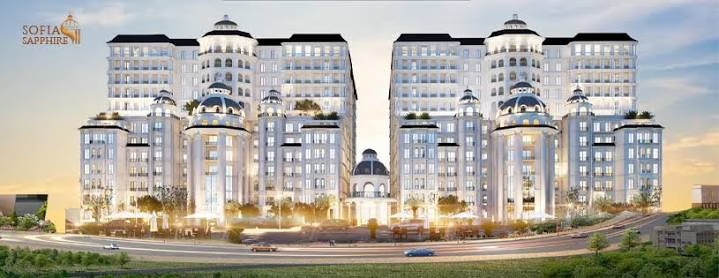
For developers, the challenge is rarely about presenting a building alone. They need to communicate scale, design intent, surrounding spaces, and the overall character of a project to investors, buyers, consultants, and government authorities. A physical architectural model allows everyone to experience the project from the same perspective, making discussions more productive and reducing misunderstandings during planning and sales.
The Sofia Sapphire project in Mumtaz City is an excellent example of why professionally built 3D architectural models remain valuable. Developed as detailed presentation models measuring approximately 1’2″ and 2’3″, the project combined precision craftsmanship with an integrated light intensity control system. Rather than simply reproducing the building, the models were designed to help stakeholders visualise the development with greater clarity while presenting the project in a professional and engaging way.
Why Physical Models Continue to Matter
Digital visualisations have become an essential part of property development, but they often depend on screens, software, and camera angles. A physical architectural model removes those limitations by allowing viewers to explore a project naturally from every direction.
This difference becomes especially important during meetings where multiple stakeholders need to evaluate a project together. Investors, architects, engineers, marketing teams, and clients can gather around a model, discuss specific areas, and understand the development without navigating digital software or relying on pre-selected viewpoints.
For Sofia Sapphire, the objective was not to replace digital content but to complement it with a presentation tool that could communicate the project more effectively during discussions and exhibitions.
The Sofia Sapphire Project in Mumtaz City
The Sofia Sapphire models were developed for a residential project in Mumtaz City, where presentation quality and architectural accuracy were equally important.
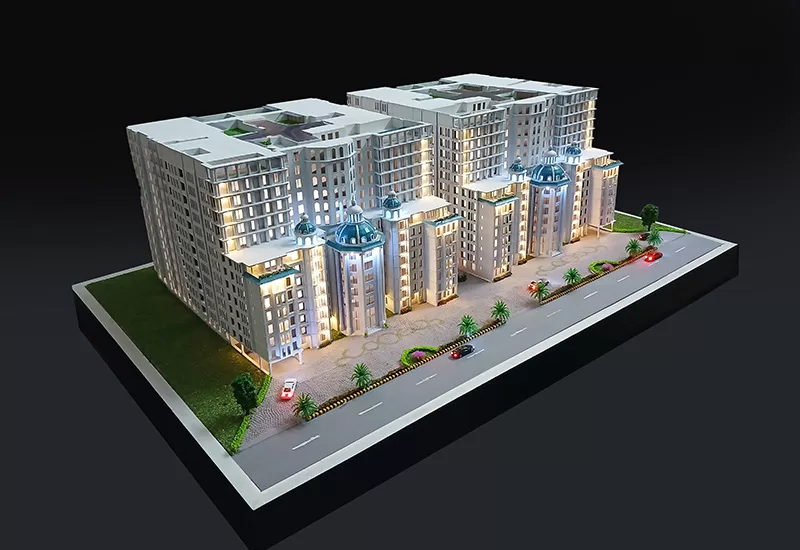
The client required two detailed architectural models in different sizes, allowing the project to be presented in multiple settings while maintaining a consistent representation of the development. Every element of the building was carefully interpreted from the supplied design information before manufacturing began.
Instead of focusing solely on the main structure, attention was given to the details that influence how people experience a development. Building proportions, façade treatments, podium elements, surrounding spaces, and lighting all contributed to the final presentation.
By approaching the project this way, the models became more than scaled replicas—they became practical tools for communicating the architectural vision.
Planning Before Production
Every successful architectural model begins with careful preparation.
Before manufacturing started, the design information was reviewed to ensure that every architectural feature could be reproduced accurately. This planning stage allowed the production team to determine the appropriate scale, manufacturing methods, assembly sequence, and finishing techniques.
For a project like Sofia Sapphire, consistency was particularly important because two separate models had to represent the same development while maintaining identical architectural details.
Careful planning ensured that every elevation, window arrangement, façade detail, and structural feature remained accurate across both presentation models.
Manufacturing Models That Reflect the Original Design
Creating a high-quality presentation model requires more than reducing a building to scale. Every component must be manufactured with precision so that the finished model communicates the design exactly as intended.
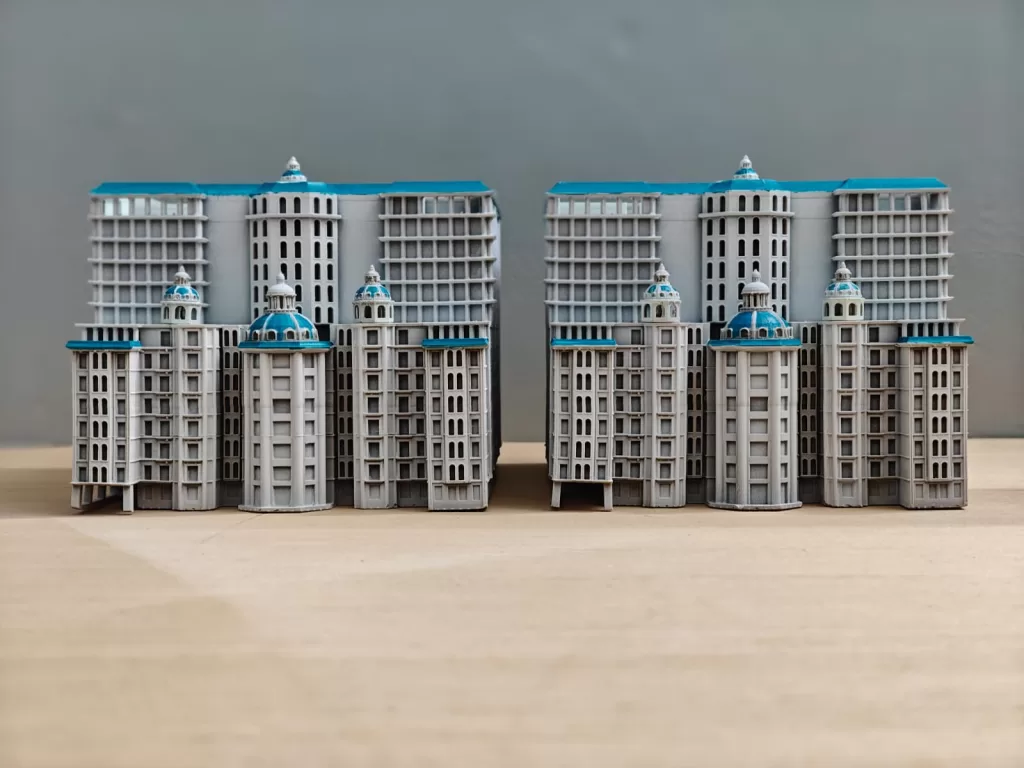
As an experienced architectural model making company, BD3D used advanced production techniques to manufacture the Sofia Sapphire models while maintaining consistency throughout the project.
The manufacturing process focused on:
- Accurate reproduction of architectural details.
- Clean façade finishes.
- Consistent proportions across both models.
- Strong structural assembly.
- Professional presentation quality.
Each stage of production contributed to creating architectural models that could confidently support project presentations, investor meetings, and marketing activities.
Lighting That Enhances the Presentation
One of the distinguishing features of the Sofia Sapphire project was its light intensity control system.
Rather than installing fixed lighting, the model incorporated adjustable illumination that allowed different presentation environments to be accommodated. Brightness could be controlled depending on the venue, whether the model was displayed in a sales office, exhibition, or client presentation.
More importantly, the lighting highlighted key architectural features without distracting from the design itself. Façades, building massing, and exterior elements became easier to appreciate, particularly in indoor environments where controlled lighting significantly improves visibility.
The lighting system was integrated as part of the model’s design instead of being added as a decorative feature, ensuring that it complemented the architecture while enhancing the overall presentation.
Precision Defines Professional Architectural Models
Regardless of size, every architectural model is judged by its accuracy.
For the Sofia Sapphire project, maintaining consistent dimensions across both presentation models required careful manufacturing and assembly. Every component was checked before installation to ensure alignment, proportional accuracy, and clean finishing.
This attention to detail ensured that both models represented the same architectural vision while maintaining the high standards expected from professional 3D Architectural Model Making & Manufacturing.
Supporting Real Estate Sales and Project Presentations
One of the main reasons real estate developers continue investing in physical architectural models is their ability to communicate a project quickly and clearly. While digital presentations are valuable, they often require viewers to navigate through different screens or rely on guided animations. A physical model provides an immediate understanding of the development from every angle.
The Sofia Sapphire models were created with this purpose in mind. Their two different sizes allowed the development to be displayed in various presentation environments without compromising architectural consistency. Whether used in a developer’s sales office, during investor meetings, or at property exhibitions, the models provided a tangible representation of the project that encouraged discussion and made complex design information easier to understand.
Instead of asking viewers to imagine how different architectural elements connected, the models presented the complete development in a way that felt intuitive. This made them valuable tools for communicating the project’s design to audiences with different levels of technical knowledge.
Why Scale Matters in Architectural Models
Selecting the correct scale is one of the most important decisions in 3D Architectural Model Making & Manufacturing. A model that is too small may lose important architectural details, while one that is unnecessarily large can become difficult to transport, display, and maintain.
For the Sofia Sapphire project, two presentation models measuring approximately 1’2″ and 2’3″ were produced to suit different display requirements. Although the models differed in size, both accurately represented the same architectural design.
This approach allowed the development to be presented in multiple settings while maintaining consistency in:
- Building proportions
- Façade detailing
- Architectural features
- Overall project appearance
- Presentation quality
The result was a flexible solution that supported marketing activities without compromising the integrity of the original design.
Attention to Detail Creates Lasting Impressions
High-quality architectural models are remembered because of the details they include.
For the Sofia Sapphire models, attention extended beyond the building’s primary structure. Surface finishes, façade treatments, clean assembly, lighting integration, and the overall presentation all contributed to a model that reflected the professionalism of the development itself.
Rather than adding unnecessary decorative elements, every detail served a purpose. The controlled lighting highlighted the building’s architectural character, while the carefully finished components created a polished presentation suitable for meetings with investors, consultants, and prospective buyers.
This level of craftsmanship is what distinguishes professional architectural model makers from simple fabrication services. The goal is not only to manufacture a model but to create a presentation piece that accurately communicates the project’s vision.
Lessons from the Sofia Sapphire Project
The Sofia Sapphire project demonstrates several principles that continue to make physical architectural models relevant in today’s property market.
Physical Models Improve Communication
A tangible model allows everyone involved in a project to examine the development together. This shared perspective encourages better discussions and helps eliminate misunderstandings that can occur when relying only on digital visuals.
Presentation Quality Reflects Project Quality
For premium developments, the quality of the presentation often influences how the project is perceived. A professionally manufactured model reinforces confidence by showing that the same level of care has been applied to every stage of the development.
Lighting Enhances Understanding
The integrated light intensity control system added flexibility without distracting from the architecture. By adjusting illumination to suit different environments, the model remained effective in sales offices, exhibitions, and formal presentations.
Precision Builds Confidence
Every component of the Sofia Sapphire models was manufactured and assembled with consistency in mind. Accurate proportions, clean finishes, and careful detailing ensured that the models faithfully represented the architectural design supplied by the client.
Choosing the Right Architectural Model Making Company
For developers, selecting the right architectural model making company is about more than finding a supplier. It is about choosing a team capable of translating architectural drawings into a presentation model that communicates the project with clarity and precision.
When evaluating a modelling partner, consider whether they can:
| Capability | Why It Matters |
|---|---|
| Interpret architectural drawings accurately | Preserves the designer’s original intent. |
| Produce multiple presentation scales | Supports different marketing and presentation requirements. |
| Integrate lighting systems | Enhances visibility and presentation quality. |
| Deliver consistent craftsmanship | Creates confidence during client and investor presentations. |
| Manufacture custom models | Ensures every project receives a tailored solution rather than a standard approach. |
Experienced architectural model makers understand that every project has different objectives. Some models are intended for planning, others for sales, and many for investor presentations. The manufacturing process should always reflect those goals.
Why Developers Continue Choosing Physical Models
Technology has transformed how real estate projects are presented, but it has not reduced the value of physical architectural models. Instead, digital tools and physical models now complement one another.
The Sofia Sapphire project illustrates this balance. Digital drawings and visualisations provided the technical foundation, while the finished architectural models gave stakeholders something they could physically examine, discuss, and experience together. Features such as the integrated light intensity control system added another level of realism without taking attention away from the architecture itself.
For many developers, this combination remains the most effective way to communicate a project from planning through to marketing.
Conclusion
Real estate developers continue to use 3D architectural models because they provide a level of clarity, interaction, and presentation quality that digital tools alone cannot always achieve. They help communicate architectural intent, encourage meaningful discussions, and allow projects to be experienced from every angle.
The Sofia Sapphire project in Mumtaz City demonstrates how professional 3D Architectural Model Making & Manufacturing transforms architectural concepts into presentation-ready models. By combining accurate craftsmanship, carefully selected scales, premium finishes, and an integrated light intensity control system, the project created models that supported both technical understanding and professional project presentations.
If you are looking for experienced architectural model makers or a trusted 3D model making company for your next residential, commercial, or mixed-use development, BD3D delivers custom architectural models built to meet your project’s unique requirements. Explore our Services, Portfolio, National Projects, and International Projects to see how our team helps developers present their projects with accuracy, quality, and confidence.